Social Analysis / 21/11/2026
A Developing World.
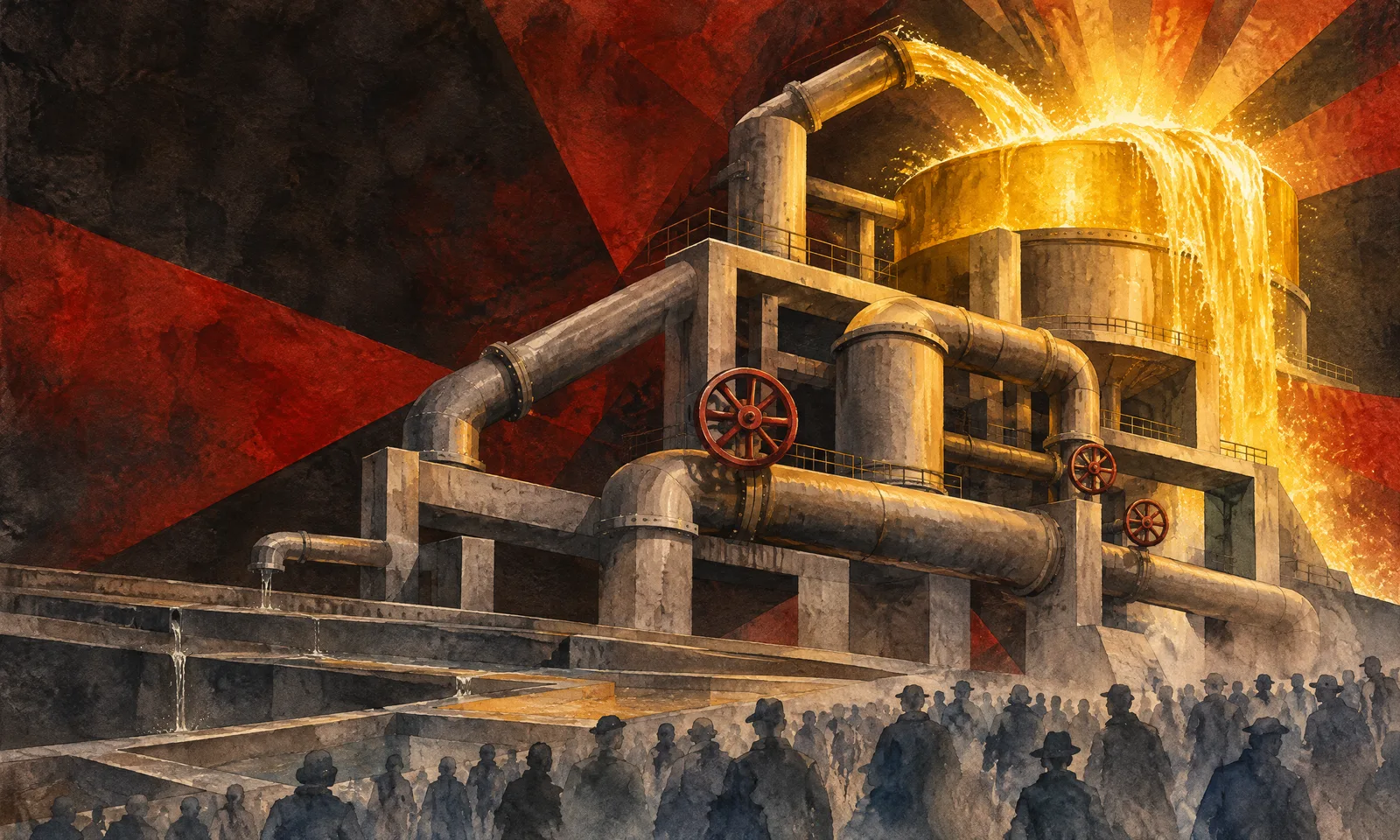
Our world, our modern world, different from any other ancient worlds, runs on the abstract, jargon-ish structure of modern economics. It is surprising that, with so few people that can actually understand it, it is still being accepted by people in most countries as the default socio-economic system.
The hardest, most abstract, most profound, most difficult component of this system is the discipline of economics.
This discipline has undoubtedly provided humanity with numerous magical tools and has averted numerous disasters, such as the Brazilian inflation. But the purpose of the article today is not to praise economic theories, but to discover, with the eyes of the discipline of economics (especially microeconomics), how the world today has gone wrong.
While modern society consists of countless social classes, roles, and people with different identities as well as socioeconomic positions, classical economic theory has no consideration for the difference between their behaviors. A.W. Phillips is an economic theorist that was most active in the 1950s, who introduced the Phillips curve, which is a now abandoned economic model measuring the relationship between unemployment and inflation rate.
His theory is abandoned for its uselessness in the stagflation of the 1970s. The only and most fatal problem of his theory is that he expanded the pattern in economic data for a certain period of time to all times. His theory is based on economic data in the UK from the late 19th century to the early half of the 20th century. But in the 1970s, the global oil crisis broke out and supply was deeply affected. The economic downturn of that time, as well as the inflation, has nothing to do with the unemployment rate, as his theory might suggest, but is just a result of external conflicts.
This particular aspect of his theory is abandoned, but he still has many other theories and models that are still somehow echoing today. One of his great innovations is a machine that he utilized hydraulic mechanism to solve the differential equations in the economic theory of the great Keynes, which are difficult to solve with computers of that time. This innovation was soon no longer needed for the rapid advancements in computer technology, but it was still used for some years in universities for a straightforward and graphical explanation of some of the most influential and useful economic theories.
Nowadays, computer simulations and videos are enough to replace his machine, but this idea of an equation and an eternal law of economics still governs modern-day macroeconomics, and equations as well as models still resemble the water machine of his time, which does not take much account of people's decisions, irrational behaviours, emotional outbursts, or external shocks.
Above is one major flaw of macroeconomics: that it only considers the economy as a mathematically sound and (mostly) predictable result of one equation, one model, or of multiple equations and models.
But beyond that, let's ask the fundamental problem, which is the purpose of the discipline of economics. We all agree that the government should act for the general improvement of life for all of its citizens, and that growth should benefit all.
Is that the case?
Large-scale research data and individual examples can all prove otherwise. During the whole course of 1993 to 2024, the average income of American citizens has increased by 40%. But if we take a deeper look, the top 1% have seen their income grow by 120.7%, while the lower 99%, which is from people earning nothing to people earning half a million dollars, have only seen their income grow by 26%, which means that the top 1% of the population counts for 43% of the whole growth. In recent estimations, taking into consideration the fortune boom caused by the AI industry, the top 1% of the population can possibly count for half of the growth in wages.
The US Federal Reserve has found in 2026, that the richest 1% of American families hold 32.5% of all of the country's wealth. And it's the highest point since the Federal Reserve started calling such data in 1989, and the lower half of American families only hold 2 percent of all the wealth in their nation. There is also research that shows that the richest 1% of men can live 14.6 years longer than the poorest one percent.
One may argue that this is the bare result of free market competition. But research has shown that one year of quality time at age 3 or 4 can increase a person's income for up to 40%. Do you really agree that children who are just born in an unfortunate household deserve to live a more miserable life than their peers that are born in households with billions and billions in their pockets?
And yet more fundamentally, do you really agree that the amazing economic and technological growth our world has been capable of in the recent 4 decades is only the result of the labor of the most intelligent and the most wealthy 1% of the population? Do you really agree that without the cheap labor of developing countries, without the factories of China, India, and Bangladesh, without the students from all over the world, without the working class who work desperately to make a living, the world can be as prosperous as it is now?
Now the world is not looking any better for all the underprivileged. In his famous book, The Undercover Economist, Tim Harford, a renowned economist, states plainly that in the future, many people will have almost no economic value at all, and there will be nothing they can do that a robot cannot do more quickly, safely, cheaply, and reliably. And perhaps most humans will not be able to compete while earning any kind of living wage. All the economic returns would go to the owners of capital.
In recent days, we have seen yet many other breakthroughs. The Riemann hypothesis, which is the most difficult question in all of the history of mathematics, has been solved by Claude, an AI. With advancements in art, design, music, image, speech, mathematics, physics, biology, and philosophy, there seem to be no field that a human can do better than AI, or if it's not the case now, it will be in a mere few years' time.
These cases have shown us yet again how our best economic theories, models, and policies are not competent enough to serve the welfare of all of humanity.
And to conclude this article, I shall say that we thank macroeconomics for guiding the global economy for the past 2 centuries, and we thank it for bringing our global economy to such a level that we should also say that perhaps it is time for it to slightly give up its space and give more to that of behavioural economics, microeconomics, and theories to tackle poverty and inequality, simply because we cannot accept a future world that, also in Harford's words, "99% of us will not want to live in".
Proof of Publication
This article may have been published earlier, but this proof shows it existed no later than the date below.
Comments0 comments
No comments yet.